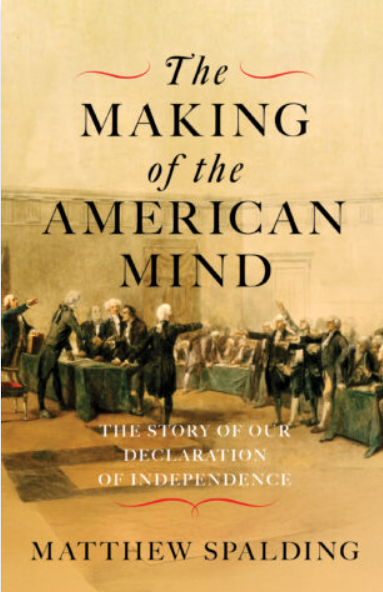
“What they possibly can mean by these words, I own, is beyond my comprehension.” Thus exclaimed an English writer in the Gentleman’s Magazine in the summer of 1776. In his very timely book, The Making of the American Mind, the Story of Our Declaration of Independence, Professor Matthew Spalding cogently answers this question, and he helps us recall the rich legacy of our Founders. He brings a passionate devotion to the Declaration’s principles to this work.
Spalding is the Kirby Professor in Constitutional Government and the Dean of the Van Andel Graduate School of Government at Hillsdale College. He oversees the Allen P. Kirby Jr. Center for Constitutional Studies and Citizenship at Hillsdale’s Washington, D.C. campus. He is the best-selling author of We Still Hold These Truths: Rediscovering Our Principles, Reclaiming Our Future (2009), and the original executive editor of The Heritage Guide to the Constitution (2005).
Spalding approaches the Declaration with a fresh perspective, deeply appreciative of our nation’s heritage. He emphasizes that the principles of virtue and liberty, exemplified by the Declaration, must be handed down to each generation of Americans. Spalding engages the reader on a wide-ranging survey of the origins, text, and principles of this document. The book is both readable and scholarly, and is extensively footnoted.[1]
The Background
In his Prologue, Spalding examines the historical background to the Declaration. He takes us back to Philadelphia in June 1775, when the Second Continental Congress authorized General George Washington to besiege the British army that occupied the port of Boston. The importance of that Congress, Spalding notes, “can hardly be overstated,” for it was “the first formal constitutional institution of American union,” which functioned as our national government. Notable men, such as Thomas Jefferson of Virginia and John Dickinson of Pennsylvania, shaped the eventual arguments for independence by chronicling the British government’s overreach, with an affirmative declaration that the colonies would sever their political connection with Great Britain. Thus, by June 1775, the groundwork was laid for the ultimate Declaration. Voices for reconciliation faded after the King declared the colonies to be in rebellion.
A year later, on June 11, 1776, Congress created a special committee to consider a declaration of independence, the so-called Committee of Five, i.e., John Adams of Massachusetts, Thomas Jefferson of Virginia, Benjamin Franklin of Pennsylvania, Robert Livingston of New York, and Roger Sherman of Connecticut. The committee’s composition achieved geographic balance among the colonies. Adams, Franklin, and Jefferson became the key individuals. The principal task of drafting was delegated to Jefferson, who shared his drafts with the other two delegates. The drafting proceeded in the background, while the delegates proceeded to a vote on the formal act of declaring independence.
Spalding recounts the July 1, 1776 debate, which did not result in unanimity. The Pennsylvania delegation voted against a declaration, concerned about the premature breakup of the British Empire by the colonies. South Carolina voted against independence. Delaware was divided. New York abstained due to lack of instructions. Fortunately, on July 2, the Pennsylvania delegation was absent and South Carolina changed its vote. With the stage set, Caesar Rodney of Delaware tipped the scales in dramatic fashion by traveling eighty miles by horseback in a rainstorm to vote for independence. Despite the high drama that had occurred, the Pennsylvania Evening Post, in its July 2 edition, recounted rather simply: “this day the CONTINENTAL CONGRESS declared the UNITED COLONIES FREE AND INDEPENDENT STATES.”
Spalding observes that the word “declaration” not only reflected Congress’s instructions to the drafting committee, but also denoted the document as one of legal import, hearkening back to prior such declarations in English history. The heading of the authenticated copy also stated that the declaration was issued by “representatives” of the United States, in other words, the “statement of a popular body acting through the republican principle of representation.” Extensive debate, which was not transcribed, occurred on July 2, because the final text of the Declaration had not been approved. That approval did not occur until July 4.
The Declaration’s Text and Its Meaning
The opening language of the Declaration (“When in the course of human events”) embodies, Spalding contends, the Founders’ belief that “individuals are participants in history rather than instruments of History.” That attitude “shaped the consciousness of the American colonists and was a key component of who they were.” Prominent examples of efforts to rein in monarchical power from British history, from the 1215 Magna Carta through the 1688 Glorious Revolution, were familiar to the colonists.
Spalding asserts that as the British parliament tried to impose additional restrictions on the colonists, the colonists determined that they needed to invoke their natural rights, which they rightly understood were antecedent to their rights under the British Constitution. In June 1774, delegate Richard Henry Lee stated that the rights of the colonists “are built on a four-fold foundation–on Nature, on the British Constitution, on Charters, and on immemorial usage.” Spalding asserts that “all understood that to stake their claim on nature would reposition their argument both to a higher and more foundational grounding, and that likely meant in irreparable break with England.”
A “long and rich tradition, going back to the origins of political thought, about the importance of nature, natural right, and natural law” animated the Founders. That tradition began with the ancient Greeks, was refined by the Romans, and elaborated by medieval writers such as Saint Thomas Aquinas. Our familiar common law jurisprudence is derived in part, Spalding explains, from a “Ciceronian understanding of law in which the primary purpose of man-made law was to protect the rights and liberties of man’s nature, as confirmed by long-established custom.” William Blackstone’s Commentaries on the Laws of England systemized that understanding, incorporating the “ancient constitution” of England, which influenced American constitutional development. Spalding also observes that the Founders were influenced by a number of English and Scottish thinkers, ranging from Algeron Sidney to John Locke. Prominent Founder James Wilson, himself from Scotland, endorsed some of Locke’s political views, but held to a common-sense philosophy that rejected Locke’s perceived “philosophical skepticism.” The Declaration was a “harmonizing” of these many viewpoints, “an expression of the American mind.”
Spalding also emphasizes that the Declaration’s invocation of the “Laws of Nature and of Nature’s God” provided the justification for the formal political separation from Great Britain. While expressed as an appeal to foreign powers for support under the international law of nations, the Declaration uses the quoted phrase to indicate that “these unchanging laws are to be the foundation of the rights and liberties enshrined in the document – the standard by which Congress’s political actions are to be judged.” The Declaration itself is best understood as drawing upon and harmonizing fundamental truths about a just political order as articulated by a number of philosophers and writers, e.g., Edward Coke, Richard Hooker, John Locke, William Blackstone, and Algernon Sidney, all squarely within the natural law tradition.
The American colonial experience also reflected a quest for religious liberty and freedom of conscience, but the Founders did not want to diminish the influence of religion in society. The phrase “Laws of Nature and of Nature’s God,” referring to both “reason and revelation,” reflected the fact that there had been a “cross-pollination” of classical philosophy and biblical theology, now embedded in the American mind. The term “Nature’s God” thus recognized a divine order and man’s role within it. The Declaration “maintains theistic substance by recognizing a precept common” to all the colonists’ faiths, that “God is the divine authority over nature and its laws.” This premise reflected the various faiths of the colonists, not simply the deistic thinkers like Jefferson.
Turning to what may be the most famous passage of the Declaration – “we hold these truths to be self-evident, that all men are created equal” – Spalding observes that the Declaration was based on the premise that “the human mind is capable of knowing the truth of things.” Intriguingly, Jefferson’s rough draft used the words “sacred & undeniable “instead of “self-evident.” Spalding delivers an insightful account of why the Committee of Five’s rewrite of “self-evident” in a subsequent draft was a more coherent choice. Prior to the Declaration, George Mason of Virginia had drafted a Virginia Declaration of Rights. No doubt that was attractive to Jefferson. The Virginia Declaration had asserted that “all men are born equally free and independent, and have certain inherent natural rights.” Spalding notes that the term “equality” had a distinct meaning for the Founders. As John Adams noted unlike animals, “man can discern right from wrong and act accordingly, and that makes men responsible for their actions.”[2]
At this point in the book, Spalding grapples with the dilemma of slavery. Spalding offers a convincing account that slaves are part of the community of “all men,” envisioned by the Declaration, even though slavery existed throughout the colonies. He finds it remarkable that the Declaration’s signers could adhere to the “equality” phrase, which he contends “is a clear repudiation of any claims of the justice of slavery.” Spalding acknowledges the contradiction of slavery as embodied in Thomas Jefferson himself, citing his various anti-slavery writings, even as he maintained ownership of over 100 slaves. Yet, the Founders assumed that the institution of slavery would disappear over time, and the Declaration embedded “the principle that would drive slavery toward extinction by recognizing a contradiction that could only be solved by ending slavery in the new nation.” Both John Quincy Adams and Abraham Lincoln found in the Declaration a fundamental principle that was inconsistent with the slavery institution.
Spalding continues his discussion of the moral core of the Declaration with an analysis of how all men are “endowed by their Creator with certain unalienable rights,” and the companion declaration that among these rights are “Life, Liberty and the pursuit of Happiness.” The rights at issue are “inalienable because they are fundamental to our very being and cannot be alienated, taken, or give away.” In his Notes on the State of Virgina, Jefferson characterized those liberties as “the gift of God.” And, Spalding notes, “the provenance of man, having been created and endowed especially with rational life, makes human life sacrosanct.” Liberty, derived from the Latin libertas, meaning the “condition of a free man,” in turn meant that man was to be “free from arbitrary and unreasonable interference,” and the affirmative ability “to exercise free will and generally make one’s way in life.”
But liberty does not mean “unfettered freedom.” George Washington, for example, distinguished “the spirit of liberty from that of licentiousness.” Spalding emphasizes that liberty also was not to be an end, but was to be “in the service of others.”
The term “pursuit of Happiness” is not limited to the individual’s quest, Spalding explains, but rather to the happiness of the entire society, as John Adams wrote in a 1776 essay. [3] This phrase was not newly-minted in the Declaration, but instead, it was used in the early 1700’s. It conveyed not simply the “more immediate and bodily sense of happiness,” but “a more substantive and ethical meaning.” The analog was the Greek word eudaimonia, or “the human flourishing and well-being associated with a good and meaningful life, of becoming in fact a good person rather than just feeling good.” Virtue also was closely linked to happiness at the Founding. Finally, Spalding explains that the word “pursuit” means the right of man to pursue happiness, but that is not guaranteed, and government “is limited to securing the pursuit, not the goal.” Citing the Neo-Scholastic concept of status viatoris – “that man, by nature, is in the state of being on his way” – Spalding explains that man is on a journey in life to an ultimate end, communion with God.
Spalding acknowledges that the general description of Liberty is not expressly comprehensive. For example, it omits the right to property (although the word property appeared in a draft), but that omission does not undermine its importance as a recognized right. Religious liberty also is not specifically mentioned, but that omission did not suggest the signers’ lack of dedication to its preservation. Spalding’s overriding point here is that the quoted statement was understood as an “all-encompassing set of man’s core rights.”
The last two self-evident truths constitute the key principles of “consent of the governed,” and the people’s right to “alter or abolish” one form of government and to institute a new one. The first relies on what was the “primary liberty of English constitutionalism.” This principle has deep roots, as early as Cicero, the Magna Carta, and early British declarations of rights. Although the Declaration does not specify how “consent” is achieved, Spalding notes that the colonists’ grievances against the King focused on his denial of their right to self-government. Finally, the colonists justified their right to sever their ties with Britain and institute a new government on traditional understandings as to why governments were formed, citing Cicero’s observation that “laws were invented for the safety of citizens, the preservation of States, and the tranquility and happiness of human life.”
The Rationale for Our Independence
Spalding next explains the colonists’ grievances against the Crown and how those grievances shaped the Declaration. He emphasizes that the Founders created our government within the natural law tradition that valued prudence as the “cardinal virtue of politics.” Prudence, another word of classical origin (in Greek phronesis, the Roman Latin prudencia) is “thinking that governs action and is focused on what is good and bad for human beings, seeking the good in each situation.” Prudence thus is “central to moral virtue.” John Adams stated that “Without prudence to weigh and deliberate on the nature and consequences of an enterprize, and to consider his means and his end,” man is committing himself to “chance.”[4]
Spalding applies this teaching to the very gradual process by which the colonies determined whether to declare independence. It is only in hindsight, that we can conclude that the decision was “obvious and straightforward.” The Declaration is a “powerful example” of prudential thinking, for its structure and argument proceed artfully from the principles discussed above. The Declaration explains that the decision to separate “should not be light and transient,” and it recites “a long train of abuses and usurpations” by England, ultimately motivated (the signers contended) by a “design to reduce them under absolute Despotism.” Independence was “justified as a matter of right but also an act of prudence, as the morally right decision in the face of actual despotic rule.”
Spalding next describes the various grievances (he counts twenty-seven) in the Declaration. Much like a prosecutor presenting a case, or proving an indictment, the colonists appealed to the “impartial jury of ‘a candid world,’” to hear evidence of “an absolute Tyranny.” Many of these grievance will be familiar – including the quartering of British troops (a prohibition embodied in the Bill of Rights’ Third Amendment). Most of the impositions arose out of England’s need to pay its debts from the French and Indian (Seven Years) War. The American colonies had benefited from what Edmund Burke called a “wise and salutary neglect” – until Parliament imposed taxes and duties. The colonial assemblies were dissolved after they protested the impositions. As Spalding observes, the grievances were founded on a legal standard – the “core liberties” of the English constitutional tradition, including, inter alia, “the primacy of lawmaking and legislative government,” the independence of the judiciary and the importance of trial by jury, and “no taxation without representation.”
The Declaration’s Legacy, and A New, Distinct People
The Declaration also leaves its mark on our Constitution. As Spalding explains, many of the Constitution’s protections can be traced back to colonial grievances, including securing the “consent of the governed” through “actual representation” in the legislature, the vesting of the war power in Congress, an independent judiciary, a right to jury trial, and that each state is guaranteed a republican form of government. The Declaration’s “rejection of absolute power foreshadowed a constitution of separated powers and coordinate branches – legislative, executive, judicial – and led to a robust mechanism of government designed to prevent tyranny.”
The Declaration includes an appeal to “our British brethren.” Spalding explains that the colonial experience, separated from Britain geographically and now politically, enabled Americans to identify themselves as a “distinct people, ruling themselves and controlling their own affairs,” the earmark of sovereignty. The closing paragraph (“We, therefore, the Representatives of the united States of America, in General Congress assembled”) reflects the Continental Congress speaking to the world as a sovereign legislative body, with a standing equal to the British Parliament. Spalding also observes that an ambiguity inheres in the Declaration’s articulation of a nascent dual sovereignty between the new federal government and the former colonies (who are now states); Spalding terms it an “incomplete concept” that will be worked out as the nation develops. The Declaration sets forth “an early recognition of a unique idea of different sovereign political institutions within one sovereign nation.”
As Spalding has noted, the Declaration invokes God in several contexts, beginning with its reference to the “Laws of Nature and of Nature’s God.” The Declaration concludes with an appeal to the “Supreme Judge of the world for the rectitude of our intentions,” and, “with a firm reliance on the protection of divine Providence,” the signers mutually pledge to each other “our Lives, our Fortunes, and our sacred Honor.” The religious terms, Spalding emphasizes, are not those of Enlightenment materialism, nor deism, but recognize God through “reason and general revelation, through human nature and creation,” and then an “acknowledgment of God’s judgment and providence in human affairs.” Its “theology” is not doctrinal nor distinctly Christian, but is a “natural theology” and one that understands revelation and the role of a creator God in this world “as the source of law and rights,” and a guide to man’s “highest ends.”
The Declaration’s final sentence, and perhaps its most stirring and inspirational, recites the signers’ pledge of “our Lives, our Fortunes, and our sacred Honor.” Spalding characterizes it as a solemn public pledge, with a special emphasis on honor as a virtue. “Sacred honor is human excellence that is honorable before God,” a conception of man who is “willing to sacrifice and suffer for the highest of ends.” In an Epilogue entitled, “Iron Men,” Spalding details the tangible sacrifices of the signers. That phrase is based on then-Senatorial candidate Abraham Lincoln’s words about the Revolutionary War generation during his July 10, 1858 address in Chicago, in response to Senator Stephen Douglas. A number of those patriots suffered losses during the War, such as losses of their property and their personal freedom – including some captured by the British.
Spalding has done outstanding work in encapsuling the history and ongoing importance of the Declaration of Independence. He echoes Lincoln’s hope that contemporary Americans will preserve the Declaration’s principles and truths and remain connected to them. We should remain united “as a people in common purpose” with a stake in our “common citizenship.” Spalding hopes that we too can be “made of iron” and support the Declaration in this generation. His book engages the reader in both the fine details and the overriding importance of this founding document to our present time and to future generations.
[1] Not surprisingly, many books on the Revolutionary Era are being published during our 250th Anniversary. I note with approval Michel Auslin, National Treasure, How the Declaration of Independence Made America (Avid Reader Press 2026).
[2] Letter from John Adams to Charles Adams, February 24, 1794.
[3] Adams, “Thoughts on Government,” April 1776.
[4] Letter from John Adams to Benjamin Rush, April 12, 1807.